Gary Jackson: Fire When Ready Pottery
A Chicago potter’s somewhat slanted view of clay & play
Categories: pottery, process, production, studio

The weather may have been miserable today… too cold & rainy to play outside…
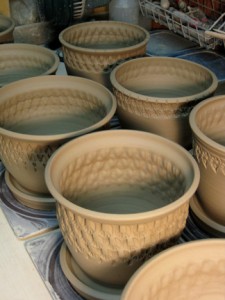
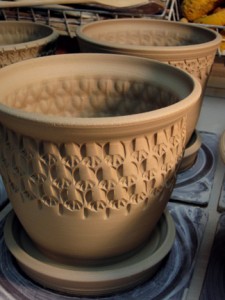
so I had some “quality time” to make some new pots in the studio!
“Hope springs eternal”… or, based on today’s weather… Spring hopes eternal!!!
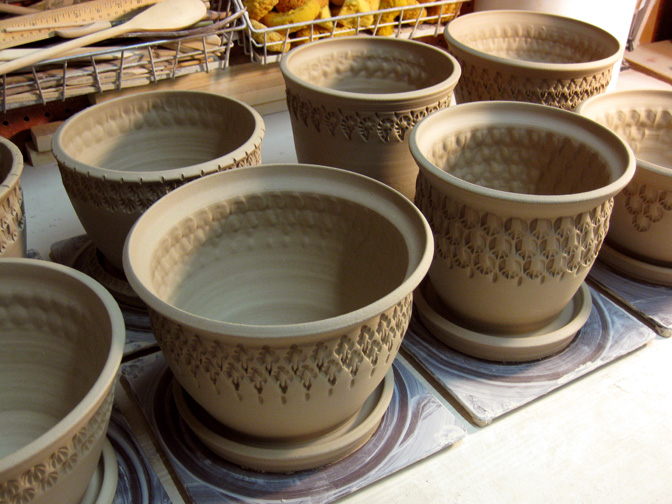
Either way… Spring is in the air… so it’s time for some new flower pots!!!

gary-jackson-flower-pots2

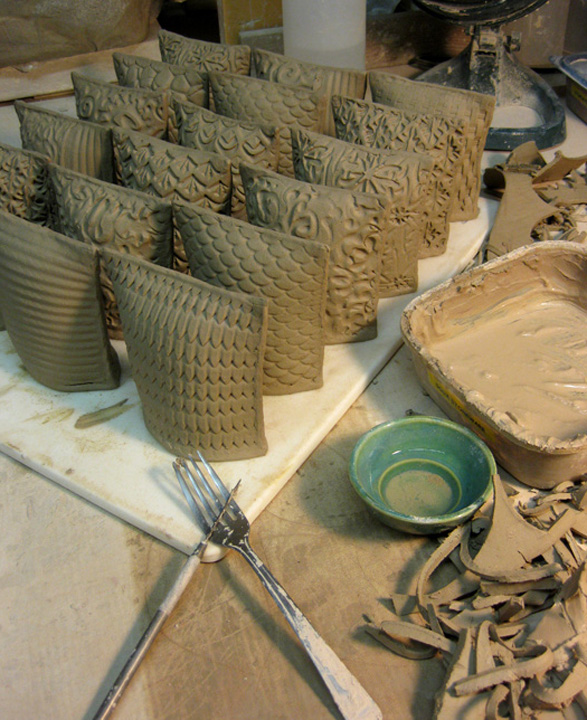
They’ve been thrown and stamped… now they just need to be trimmed, have drainage
holes pierced through, slip decorated, dried, fired, glazed and fired again!
Just in time for those summer plants on your back porch or windowsill!

gary-jackson-flower-pots1gary-jackson-flower-pot

Categories: classes, lillstreet, pottery

Looking for something fun to do this Spring?
Longing to get your hands dirty – but don’t have a garden to play in?

The new Spring Session of classes starts next week at Lillstreet Art Center.
Mark your calendar as my class starts next Tuesday, March 24th, 2009.
I will once again be teaching my class on Tuesday nights from 7:00-10:00pm.
My class is Beginning & Advanced Beginning Wheelthrowing.
It’s a 10-week class that meets every Tuesday night for three hours. You’ll learn
the basics of wheelthrowing and every step along the way to your finished pots!
Whether you are a complete novice, or an experienced beginner, this is the class
for you. We’re all very low-key, very social and very fun!

Lillstreet Art Center offers some of the best clay opportunities in Chicago!
In addition to your scheduled class session, you also get open studio time at Lillstreet
seven days a week – what a great chance to play inside & practice slinging mud!
So if you’ve ever wanted to play in the mud and make some pots…
it’s still not to late to sign up for classes at Lillstreet Art Center.

Registration is easy – just register online at www.lillstreet.com.
But hurry… my class generally fills up quickly.
Avoid the waiting list… register today!

Categories: inspiration, photography, pottery, process, sunrise

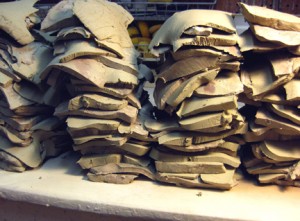
Oh, what to do with all those dry clay scraps?…
Well, turn them back into new clay again of course!!!
Yep, all of those dried trimming scraps can be re-hydrated into new clay
and used again to make a new pot!

So I take all of my trimming scraps and allow them to dry out completely.
I keep them in a large plastic bin for “safe keeping.” When there’s a good amount
of them, I fill the container with water just above the clay level. The water will soak
into the dry clay and allow it to “slake” down. After the clay has absorbed the water,
I let it sit for weeks… or at least until I feel I have time to deal with it.

When I feel that the dried clay is rehydrated, and the majority of the water has either
soaked in or dehydrated, I scoop out handfuls of the new clay mixture and place it on
a large slab of plaster. This will help draw the excess water out of the mixture. I typically
leave the pile of clay sitting on the plaster bat for a few days until enough moisture has
been drawn out and the mixture is now close to a normal clay consistency. Then, I take
the clay off the plaster bat and get ready for some “heavy lifting.”

gary-jackson-reclaim1

gary-jackson-reclaim2

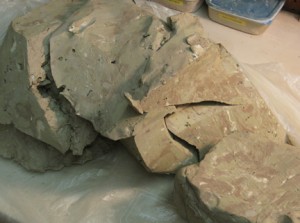
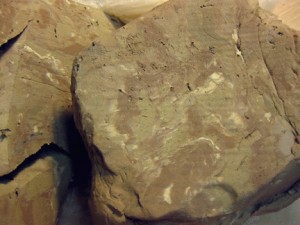
As you can see, I don’t worry too much about what kind of clay scraps get into my reclaim.
In fact, some of my other studio mates don’t reclaim their scraps… so them give them to me!
You just need to make sure that all clay going into your reclaim bin is rated for the same
kiln firing temperature.

I then take slices of the new clay, and interleave them with layers of fresh clay straight out
of the box. As the majority of my work is fired in the soda kiln, I generally use fresh
soda clay when I’m layering so that I know that at least half of it is for the soda kiln.

gary-jackson-reclaim3

Now that I have stacks of mixed clays, I start pounding them together. It’s actually
easier than it sounds. Just pick up the entire stack, and slam it back down onto the
table. Cut it in half, stack the halves on each other – and slam it down again.
Slice-stack-slam-repeat. Slice-stack-slam-repeat. And so on… and so on…

gary-jackson-reclaim4

Seen above, I’ve only sliced, stacked & slammed once. See the layers are still apparent?
Assume you are starting out with 10 layers. Slam them down, cut it in half, stack it on itself…
now you have 20 layers. Repeat… and now you have 40 layers. Repeat… and now you have
80 layers. Then 160 layers… 320 layers… 640 layers… etc. So the more times you do it,
the thinner the layers become and the more incorporated your different layers become.

Once I have sliced & slammed the clay and feel that they clay is well incorporated, I pound
roughly into cubes and store it in recycled clay bags. This reclaimed clay is now ready to go!
Yesterday, I reclaimed over 175 pounds of recycled clay – that would have otherwise been
thrown away. Even better… with just a little effort, it’s like FREE CLAY !!!

Categories: pottery, process, production, stamps, studio, tiles

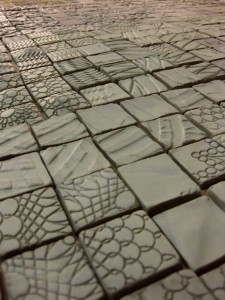
Spice it up with textures & tiles…
and trying to combine the two into new salt & pepper shakers!

So I’ve been working on a new batch of shakers that combine the textures
of my tiles, the soda fired colors & flashing – with the functionality of
salt & pepper shakers! They’re still in the works… with trays to come!

gary-jackson-tile-sp-production1

Once the shakers are built, I’m applying a thin coat of soda slip on some
of them to give them different colors & flashing effects to be created in the
soda firing atmosphere. Seen below before & after…

gary-jackson-tilesp21gary-jackson-tilesp11

Categories: pottery, process, production, stamps, studio

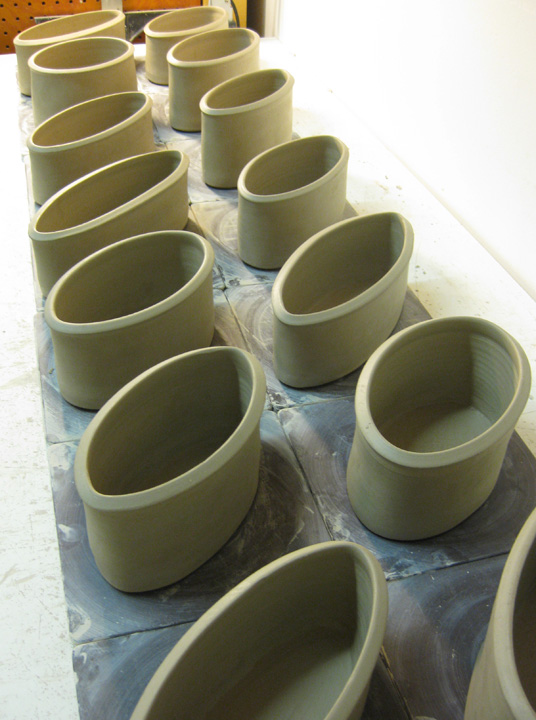
Back in the studio… making oval vases again.
First thrown as a bottomless cylinder, then squished into an oval, then
the floor is added… and then ready to be stamped! It’s ovals… before & after!

gary-jackson-ovals-plain2

gary-jackson-ovals-stamped

Categories: bike, photography, pottery, process, production, stamps, studio

So tonight I put some “finishing touches” on the mugs!

As part of the soda-firing process, a lot of the color accents achieved
come from colored slip applied to the surface. Slip is just watered down clay
with special chemical colorants added. These chemicals react to the
soda atmosphere and create dramatic colors and random flashing marks.
Slip generally needs to be painted onto the clay body while it is wet
or leather-hard. I typically paint the slip on after stamping, trimming
and applying handles. It’s usually the last step before I let the pieces air-dry.

Tonight I painted slip accents onto the mugs… both along the top rims
and some of the smaller details inside each of the stamps. Yes, it’s true…
each and every little stamp, one by one… each one with a touch of slip!

gary-jackson-slip-painting-mug

Now that they are all painted, I can let them air-dry… and then bisque fire
the mugs when I accumulate a kiln-full of greenware (dry clay). Once fired,
the mugs will be glazed and fired again. A few more steps in the process…

gary-jackson-mugs-drying

Categories: bike, nature, pottery, process, production, stamps, studio

One of my favorite things to make… mugs!

Many potters despise the process; mostly because of their fear of handles.
But I enjoy making the smaller, personal items that become part of people’s
everyday rituals. The morning coffee, the winter’s hot chocolate, the cup of tea
for those feeling under the weather… or in my case… ice cold grape pop!!!

So I’ve spent the past few days working in the studio on a new batch of mugs.
Nothing fancy – just trying to get back into the swing of things and restock
the “art fair inventory.” And I thought I would try to show you some of the steps
along the way.

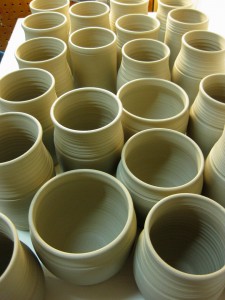
First, I start by throwing the basic cylinder shapes. I prefer to work
in “batches” instead of singles. I like the production aspect of it all.
Creating a quantity of something… then moving on to the next.
gary-jackson-thrown-cylinders

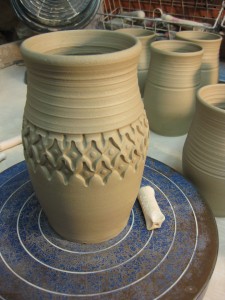
When they are a fairly damp “leather-hard” I begin the stamping decoration.
I make my own stamps out of a piece of clay. I roll it into a coil, carve a pattern
into both ends and bisque the stamp. One stamp pressed in repeatedly can create
a wonderful pattern around the cups. The trick is to get the pattern to line up
when you get back to where you started!!!
gary-jackson-stamped-mug

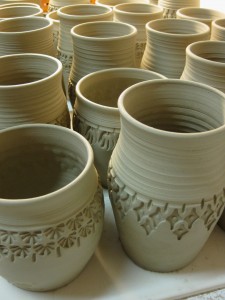
After they are stamped, the bottoms are trimmed. It’s a fairly simple process
where you turn the cylinder upside down on the wheel, center it, attach it,
and then trim away the excess clay while it is spinning. Think of it as very
similar to a wood lathe. Spinning fast, trimming fast. Trimming helps remove
the excess clay where it attached to the wheel, as well as allowing me to trim out
the bottom to create a finished looking foot ring.
gary-jackson-stamped-mugs

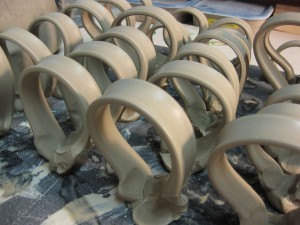
After trimming, the handles are pulled and allowed to stiffen up.
Once they are no longer sticky, wet or mushy, I can apply them
to the side of the cylinders to create a “not-quite-so-instant” mug!
gary-jackson-pulled-handles

To attach the handles, I cut out the section of the strap that I need…
then scratch & slip both the ends of the strap and the attachment points.
The scratching works like Velcro, the slip works like clay glue. Together,
it creates a strong bond when attaching clay to clay.

gary-jackson-attaching-handles

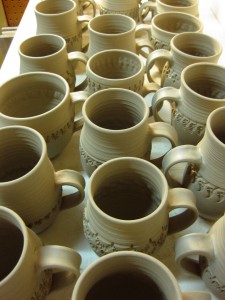
After attaching the handles, I take a few extra moments to smooth them out
and give them a finished look. I then set the mugs aside and cover them with
plastic to help them dry more slowly. I like to keep them covered for at least a day
to help the moisture level of the mug and handle equalize a bit before full drying.
gary-jackson-rows-of-mugs

Once the mugs are done and all handles are attached, I will paint some colored slip
on the mugs that are going to be soda-fired. The colored slip will help add some color
to the final mugs – as well as reacting to the soda environment of the kiln to create
some wonderful flashing effects.

After slip painting, the mugs are allowed to dry slowly. They then need to be bisque fired
to approximately 1850-degrees. This makes them hard yet porous. Next they are glazed,
wadded and fired again. The final soda firing takes around 13 hours to reach the top
temperature of 2350-degrees. The kiln will cool for a full day, and be unloaded the next.

All of that for a simple mug.
Categories: pottery, process, production, tiles

Tiles… tiles.. and more tiles!
I spent last night making a lot of tiles in the studio… more than I had planned!
Each tile is handmade from a slab of fresh clay. Each tile is textured by hand
creating one-of-a-kind tiles that will later be put together into hanging
wall pieces or installations. My sister has “requested” a wall installation
for her living room between some cabinets, around the wall mounted television.
So I’m back in production mode – making a lot of tiles! Many of them will be used
for her wall installation, while others will get to travel on the summer art fair circuit.

gary-jackson-tile-production22

This batch will be for the soda kiln, so not only were they textured,
most of them are also covered with a layer of soda slip which will help give them
different colorations in the final glaze firing. So now they need to dry, then be
bisque fired. When I get ready to do my next soda firing, they will all need to be wadded
individually, as well as given a quick wash of dissolved soda solution and some get
a minimal spraying of glaze for a splash of color. A lot of work for a little tile, huh?
Now multiply that by hundreds of tiles…

Categories: pottery, process, production, stamps, studio

So I’m back at the studio – trying to get back into the swing of things
and get the pottery production started up again. I figured a good place to start
would be by making some new stamps for the New Year! With even more to come…

gary-jackson-new-stamps-2009

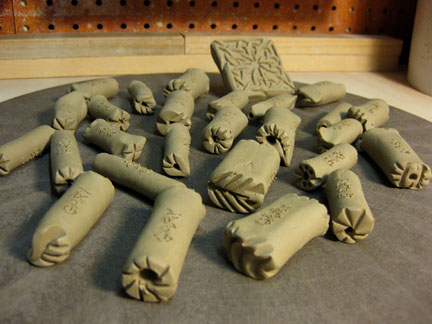
I make my stamps with fresh clay – and start by rolling out a coil.
I let the coil dry up a little bit so it’s not too soft & squishy. Then I will create
different patterns on both ends of the coil. That way, I get two stamps with each.
As the coil dries, I make sure to scratch my name into the side… you know how
things tend to “travel” around the studio?! When the stamps are dry, they will be
bisqued to make them solid, yet porous. They are then ready to use. You want to
make sure not to high-fire them as that would make them non-porous…
and they would stick more to the clay when making impressions.

Categories: pottery, special events

Once again, the “Empty Bowls” project at Lillstreet Art Center was a great success.
Thanks to the efforts of Joanna Kramer who organized the event, an astounding $10,865
was raised in just one night. I would like to think that my donation of a dozen bowls
helped make a difference.

“Empty Bowls” is a nationwide philanthropic effort by potters around the country
to raise money for the homeless & hungry in the country. By donating handmade
ceramic bowls, the potters are helping raise awareness and money for the cause.
At the event, people can purchase these “empty bowls” for $20 and then get it filled
with soup & bread donated by First Slice Cafe. They then get to keep the bowl
as a symbolic reminder of their generous support of the cause.

Thank you to all the potters & bowl shoppers who make this event a success nationwide!